

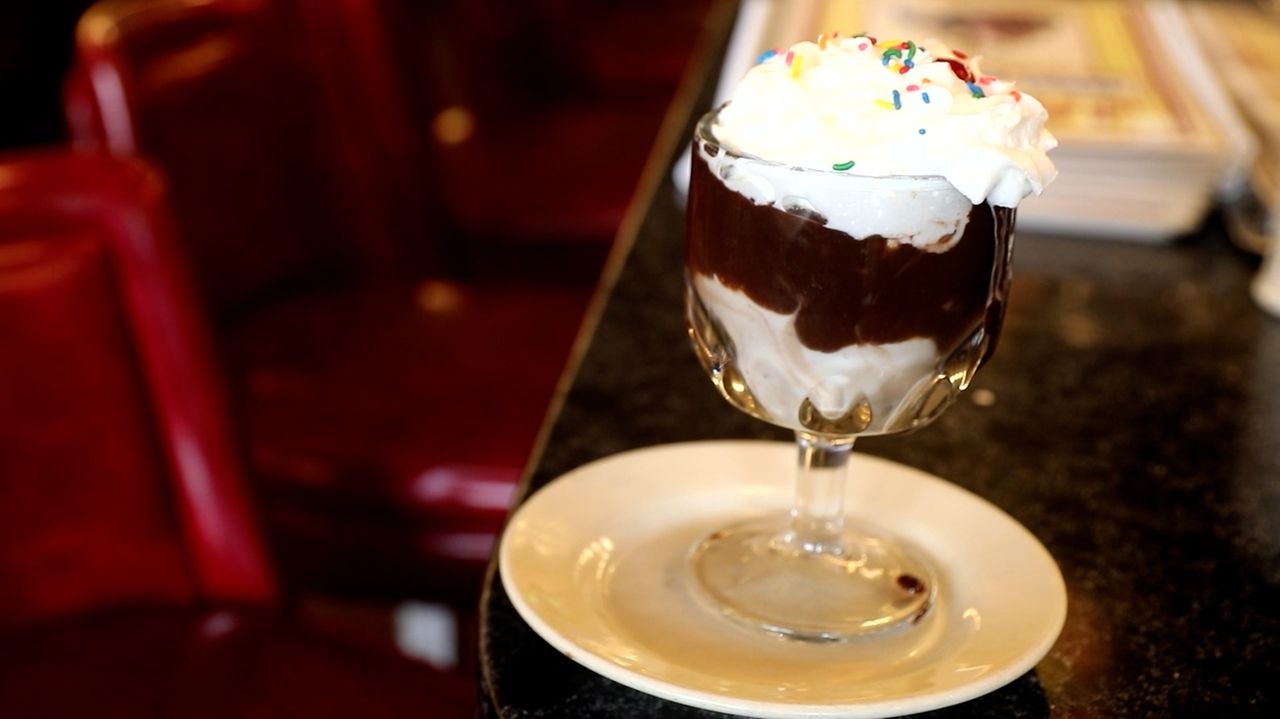
Here’s the scoop: Long Islanders loved Jahn’s, the chain of ice cream parlors with at least seven outposts here from the 1950s until closing down bit by bit through the ’80s. A single store in Queens is all that remains of the more than two dozen that dotted New York, New Jersey and Florida like sprinkles on a cone.
Its passing left a void. Unlike most ice cream shops today, with counter service only and virtually no seating, these were sit-down places for families and, especially, teens. Servers came to your table to take your order — whether for a simple sundae or the colossal Kitchen Sink, a communal concoction of every ice cream and topping the place had to offer. There was cooked food as well, but ice cream was the star.
A Newsday ad for one of the Jahn’s Ice Cream Parlours, a once-thriving chain of ice cream restaurants with only one remaining location, in Jackson Heights, Queens. Credit: Newsday
“It had a very old-fashioned ice-cream-parlor vibe,” said East Northport’s Denise Schwartz, 61, who grew up in Mineola and favored the Jahn’s in East Meadow, next to the now also long-gone Levittown Roller Rink. The decor was less Archie comic book’s Pop’s Chock’lit Shoppe than it was Victorian salon — “dark wood and those old Tiffany-style lamps over the tables,” said Natalie Krempa, 54, a fiscal intermediary coordinator who lives in Holtsville and was raised in East Meadow.
The menus promised such delights as a Flatbush (strawberry ice cream with chocolate syrup), a Twosday (two sundaes and a soda) and a host of dishes with only fanciful descriptions, for which presumably the server would tell you the ingredients: the Flaming Desire (“A slow burn with a fast finish”), the Wha Hoppened (“Don’t ask us”) and the Brooklyn Kibitzer (“Shut up and eat”). Thankfully, there were also plain-English banana splits and peach Melbas — and if you could prove it was your birthday, you got a free sundae.
“It was just a fun place to go, and it was so novel,” said retired school administrator Linda Scalice, 70, of Lindenhurst, who went to the West Islip Jahn’s. “I didn’t go often but we went once as a group, and I remember having the Kitchen Sink. It was in this cauldron, this big bowl, and everybody would dig in. I don’t remember if we even got extra plates. I just remember lots of spoons!”
An ad in Newsday for Jahn’s in East Meadow lists their daily hot specials, but ice cream was the star. Credit: Newsday
“It was not only that the ice cream was really good,” said Schwartz, but the service as well. “You go to a Friendly’s, you wait forever — you’re like, ‘There’s nobody in here but me. How long could this take?’ ” Even beyond food and service, it was a simply a good place for young people to gather. “I’d go with my high school friends,” she said. “I even went with the person who eventually became my husband,” who has since died.
And for some, Jahn’s represented freedom. “It was a special escape from the Long Beach High School cafeteria lunch,” said Sayville musician Joe Behar, who continues to play in jazz combos at 83. In his father’s 1955 Chevrolet Bel Air, “I would go to Jahn’s during the school year and have the hamburger special. And that was the first place I ever had onion rings.”
The chain’s namesake, John Jahn, emigrated from Germany in 1888 at age 14. After working in a bakery for five years, he became an ice cream maker at a Brooklyn store. Striking out on his own in 1897, he opened his own shop at Alexander Avenue and 138th Street in the Bronx. He took a five-year break in 1918, then returned to the business by opening a trio of stores in Queens, one for each of his and wife Clara’s children: Elsie, in Jamaica; Frank, in Richmond Hill; and Howard, in Flushing.
Glenn Chippendale and his mother, Joyce, attend the opening of Jahn’s in Herricks in this March 27, 1956, Newsday photo. Credit: Newsday
The family eventually branched out. The first two Jahn’s parlours on Long Island appear to have opened in 1955: One in Great Neck (1 Great Neck Rd.), which held its grand opening on April 16 that year, and the other in Cedarhurst (550 Central Ave.). By the following year they had opened in Williston Park (406 Hillside Ave., in the Herricks Shopping Center, opened March 1956), Rockville Centre (241 Sunrise Hwy.), East Meadow (2565 Hempstead Tpke.) and Long Beach (267-269 W. Park Ave.). By 1957, one had opened in West Islip (135 Sunrise Hwy., next to the Korvette department store).
Jahn’s and other ice cream parlors prospered, explained Nick Moukas — who with his brother, Peter, owns the last Jahn’s, at 81-04 37th Ave. in Jackson Heights, Queens — because most people had iceboxes rather than refrigerators. “You couldn’t keep ice cream at home, so you had to go out to have ice cream,” he said — even if just to bring back for dessert and eat before it melted. Ice cream parlors — cheaper than restaurants, nicer than diners — became associated with “family get-togethers, a place to be with your friends.” Moukas, 60, said.
A 1955 ad in Newsday announced the opening of a Jahn’s in Great Neck. Credit: Newsday
And in the case of Jahn’s, the shops were mostly strategically located “near skating arenas or movie theaters,” he noted. “People would go have ice cream afterward.”
Indeed, said Leonard Berkoff, 73, now of Lauderhill, Florida, “In 1964, the Beatles’ first movie, ‘A Hard Day’s Night,’ was playing at the Meadowbrook Theater in East Meadow. I was 12 so my mom took me. After the movie, we walked to Jahn’s” and shared a sundae. “That was the first of many visits to Jahn’s, after going to the movie theater or the roller rink.”
“Friday and Saturday nights during summers, there were lines to get into Jahn’s after the movies let out,” Behar said of the Long Beach store. “It wasn’t just young people — it was older people, it was people dating, it was people by themselves. It was very, very popular.”
They were de facto community centers as well. A group of 25 teenage Rockville Centre Youth for Kennedy celebrated President John F. Kennedy’s inauguration in 1961 at their village’s Jahn’s with “$40 worth of ice cream, soda and cake,” Newsday reported. And like many other groups, the local chapter of the Keren Or Jerusalem Center for Blind Children with Multiple Disabilities held a luncheon and card party at the Cedarhurst Jahn’s in 1957.
John Pobeschein, of Rockville Centre, celebrates President John F. Kennedy’s inauguration at the Jahn’s in Rockville Centre in this 1961 Newsday photo. Credit: Newsday
The Long Beach Jahn’s even appears in a half-hour film: “An American Girl” (1958), produced by the Anti-Defamation League to combat antisemitism in “nice” suburbs. Bennye Gatteys stars as Norma Davis, whose little sister Augusta (Patty Duke, in one of her first roles) gives her a pretty bracelet with what turns out to be Hebrew symbols. Wearing it, the Christian Norma finds herself ostracized by friends and neighbors who accuse her of having hidden her Judaism. Prolific character actor Frank Overton and the future Mrs. Roper of “Three’s Company,” Audra Lindley, play her sympathetic parents.
Early in the film, we see Norma and her boyfriend, Jack Ryan (Richard Ide), in Jahn’s — and when they go outside, we can see on the window “Jahn’s Ice Cream Parlour.” Populating the Jahn’s scene are Long Beach High School seniors as extras.
Eventually, as people became more health-conscious and as ice cream became a supermarket staple — Jahn’s itself had half-gallon tubs for sale in markets in the 1970s — Jahn’s stores began closing; the last ones on Long Island limped into the 1980s. Most had long introduced full dinner menus in an effort to stay afloat, but they weren’t really dinner places. The next-to-last Jahn’s, on Hillside Avenue in Richmond Hill, Queens, shuttered in November 2007.
A martini or Manhattan cost just 49 cents in March 1963, according to a Newsday advertisement. Credit: Newsday
The Moukas’ late father, Tom, who had bought the Jackson Heights Jahn’s in 1970 after working there 10 years, had shifted his store’s focus to breakfast-and-lunch fare in the 1980s. The family remodeled the place in 1987 to reflect that change and to modernize. But in 2015, they remodeled again with an eye to the past.

Nick Moukas, who with his brother, Peter, owns the last Jahn’s, in Jackson Heights, Queens. Credit: Morgan Campbell
“I wanted to bring it back to what Jahn’s always meant to me,” said Moukas, a college-educated engineer who left a job at General Electric to pursue the family business. The brothers brought back some of the store’s original Tiffany-style lamps, “but we didn’t have the ones with ‘Jahn’s’ on them. So I found a guy out on Long Island who could do them.” They met, they talked and, lo and behold, they discovered that “his grandfather had done Jahn’s lamps in the ’40s and ’50s. So he still had the stencil” for forming the name in stained glass.

The Moukas brothers hired the grandson of the original craftsman of the custom Tiffany-style lamps to recreate them. Credit: Morgan Campbell
Yet these physical details matter less than does something ineffable. Recently, Krempa said, “I was sitting with my dad and I mentioned Jahn’s to him, and he’s, like, ‘Jahn’s …,’ ” she said, in a tone of nostalgic reminiscence. “My parents went to Jahn’s in Queens — they’d hang out there when they were young.” And she herself, growing up on Long Island “got to do something similar. I liked that about it,” she said. “The whole intergenerational thing.”
Jahn’s may be gone, but it remains a sweet memory … with a cherry on top.
#Remembering #Jahns #Ice #Cream #Parlours #Home #Kitchen #Sink