

Antique or vintage homes are distinctive for their timeless craftsmanship, but they don’t always fit 2025 living.
They can mean living under imposing ceilings surrounded by intricate moldings but within cramped, closed-off rooms. Classic casement windows might let in less light. Staircases with carved wooden banisters often lead to dank, dreary cellars.
And it could cost more than the homeowner paid for the house to bring it into the 21st century.
Richard Connelly, of Douglas Elliman Real Estate, recently showed a large 1867 farmhouse on nearly 3 acres in Orient that’s listed for just under $3 million. He estimated it could easily cost an additional $2 million to renovate.
“I think it’s a very, very select few that would want to dive in and restore that home,” said Connelly, adding that when the inventory of available homes is low, as is the case right now on Long Island, these historic homes are somewhat more desirable.
And experts say renovating an older home can be less expensive than building something completely new. But it depends on the project.
Cost, demand to bring historic homes into the present
It’s a special kind of person who would want to make the commitment and investment in a historic home that requires extensive updating to bring it up to today’s living standards, Connelly said.
“It’s for the love of the style that somebody would want to do that type of renovation to keep the charm and the craftsmanship of the home, but the budget could run amok,” he said.
Typical interior alterations run $150 per square foot, while structural alterations or additions run $350 per square foot, said Frank Falino, an architect with offices in Port Washington and Elizaville in the Hudson Valley. A 2,000-square-foot home, for example, could cost anywhere from $300,000 to $700,000 to renovate.
For a lower-end project, which cost $100,000, Falino did a kitchen alteration that included removing a wall, replacing a window, redoing the kitchen, a half-bath and patching the floors.
At the higher-end for another home, Falino raised a roof, added bedrooms and bathrooms, enlarged existing bedrooms and installed all new windows, roof, siding and air conditioning, for a total of $850,000.
The demand for work has not really changed and the scope of the work has always depended on his client’s circumstances, whether it’s for a young couple, a family or empty nesters, Falino said.
“Economic changes certainly affect the scope of projects, but not the demand for work,” he said.
The goal of repurposing homes is “to preserve and accentuate and expand on the original qualities of the structure,” Falino said.
“If it has good qualities, you want to bring those out. It’s really nice to bring in more light and open the spaces up, but also maintain the feel of the original,” Falino said. “It has a lot to do with studying the scale of what the original structure is and, as you add to it, trying to add in kind.”
You can take two very different approaches to the work, Falino noted.
“You’re either creating more of the same scale or you’re doing something that contrasts with it so that it stands out and it also accentuates the old part.”
A $500,000 renovation

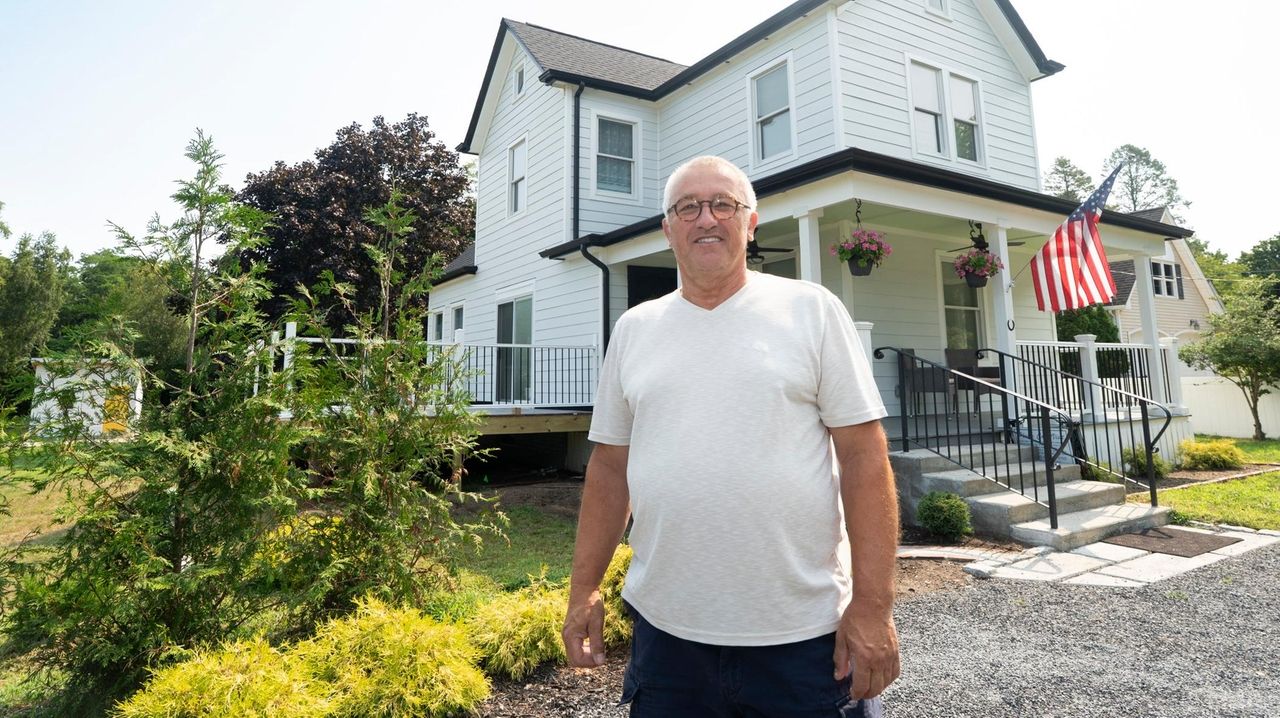
Branko Jozic kept the same look and layout of his East Marion home. Credit: Randee Daddona
A retired contractor, Branko Jozic gut renovated his 1920 farmhouse-style home in East Marion. The work included adding hardwood floors and refinishing the trim, the staircase, railings, banister and solid wood doors.
“This was an unusual house, with 9-foot ceilings,” said Jozic, 67. “Somebody said that it was a priest’s house, because the church is right there.”
Despite the extensive renovations, Jozic said he kept the same look of the house and changed neither the layout nor the framing.
“I saved the doors; I saved the casings, wherever I could,” Jozic said. “The framing was solid.”
A floor-mounted grill, top, staircase detailing, left, and original door were among the features Jozic preserved. Credit: Randee Daddona
Though he had to remove the Yankee gutters when he reframed the roof, Jozic replaced them with gutters that resembled the original ones.
“I made it more efficient with insulation, with dry walls, because I brought the house all the way down to the beams,” he said.
The renovations, which took 18 months and cost approximately $500,000, included adding wide-plank wood flooring, a porch and deck.
The house, which he bought three years ago for about $550,000, now has three bedrooms, two full bathrooms and two half-bathrooms. It’s on the market for $949,000, with Connelly representing the sale, a $246,000 reduction from the original asking price.
Seamless transition from interior to exterior
Mary Ahern designed the upstairs studio space in her Northport home specifically to fit her house and her needs. Credit: Elizabeth Sagarin
Eleven years after moving into her Northport home in 1989, Mary Ahern transformed her prewar, one-story Cape-style farmhouse into a light-filled home and artist’s studio.
“I’m only the fifth owner of the house,” said Ahern, 77, an artist whose large floral portraits and landscapes are inspired by her own garden.
Working with architect Falino, they transformed the lower level from an unfinished basement into an office for Ahern’s husband, Dave Ruedeman, who teaches information technology remotely. The whole renovation took six months, during which they lived in a trailer on the premises.
The second floor, which was added, has a primary suite and two artist studios. The main floor, previously divided into a kitchen, living room, dining room, two bedrooms and a bathroom, is now completely open. According to Falino, the cost was approximately $400,000.
“It only has one wall now,” Ahern said.
Ahern redesigned her home to have better views of her garden, which inspires her art. Credit: Elizabeth Sagarin
Despite the extensive work, much of the original structure was left intact, Falino noted.
“We preserved the footprint, general floor layout, location of kitchen and staircase, the original oak floors with cherry border inlays, most of the window locations, exterior deck, covered porch, and chimney,” Falino said.
Ahern redesigned the gardens, which she said inspires her art, so each window has a view.
“Each thing that [Falino] and I worked on was about minimizing that sense of busyness and clutter, to give it a serene feeling,” said Ahern, adding that the design also connects the interior seamlessly to the outside.
Falino completed the renovation of this early 1920s Craftsman-style home in Glen Head for $250,000. Credit: Frank Falino Architect
As was the case with Ahern’s home and studio, Falino endeavored to conform a Glen Head home to the immediate needs of the owners, a couple who wanted one of their parents to move in with them.
Several years ago, he completed the renovation of their early 1920s Craftsman-style home.
“We raised the front of the house and dug underneath, and we put a 10-foot-high basement underneath with full-sized windows and an exterior stair, and we created a really beautiful apartment downstairs for him. We added the screen porch in the back that mimicked the lines of the original house,” said Falino, noting that they also added a wraparound front porch and the total cost was about $250,000.
A 1790 home in Remsenburg was opened up to bring in more light, but “we really didn’t modernize it,” Falino said. Credit: Frank Falino Architect
After the parent died, the couple bought a 1790 Colonial home in Remsenburg in the town of Southampton.
“We went in and opened some walls and exposed the old timber framing that was part of the old house,” Falino said. “We opened that up to bring in more light and expand the space inside without changing the exterior. We really didn’t modernize it.”
As they were removing some plaster walls inside the house, they took care to salvage the wainscoting.
“They were wide boards with an interesting edge detail,” Falino said. “We saved those and we built a really beautiful little bar in the house and we paneled it with those wainscot boards.”
Falino also updated outbuildings on the Remsenburg property, some of which had been converted into cottages by a previous owner.
“One was an icehouse, which is now a sauna, which we didn’t work on,” Falino said. “We took one of the cottages and we created a pool house and added a big screen porch on the back of it with exposed framing.”
Church in Bayville
Donna Lee and her husband, Scott, live in the former Village Church of Bayville. Credit: Newsday/Thomas A. Ferrara
Though Donna Lee has made lots of changes to her home since she moved there in 1978, the building in many ways still resembles its original incarnation: the Village Church of Bayville.
When Lee moved in, there were pews and an altar upstairs. The lower level was divided into Sunday school classrooms with a little kitchenette and two bathrooms.
“In 1996 we decided to stay here permanently and then we did the renovation,” said Lee, 66, who works for the Nassau County Board of Elections. “Prior to that I was single and I didn’t want to do any renovations in case I was selling it and I wanted it to be a blank canvas for anybody who purchased it, because it was such a unique building.”
Donna Lee moved to the church in the ’70s and, after deciding to live there permanently, began renovating in the ’90s. Credit: Newsday/Thomas A. Ferrara
Before the renovation, Lee lived exclusively in the downstairs area, which, after housing a church, had been home to a community theater, an upholstery store and other businesses. Her family purchased the building after the Village of Bayville changed the zoning to residential usage.
The remodel began with turning the half-baths into full baths and then they moved on to the upstairs rehaul. Lee did not want to disclose the exact figures, but said the renovations cost more than what she paid for the house.
“Since the building was not used and it had plaster walls, we had to laminate all the walls,” Lee said. “But really what was important to us was not to lose the beauty of the building and the stained glass and have the openness of the church. So, we didn’t erect any walls except for one small half wall where we put our galley kitchen.”

Donna Lee holds a snapshot of the historic Bayville church that would become her home. Credit: Newsday/Thomas A. Ferrara
Now, the lower level has four bedrooms and two full bathrooms. The main or upstairs area has a living room, dining area, kitchen and half-bath.
“When you’re on the street level and you open the street level door, you can either go upstairs or downstairs,” Lee said. “The upper level is basically an open room divided by furniture loft-style. That’s how we adapted it to our needs for raising a family and calling it our home.”
The Lees kept a lot of the original church fixtures, though they re-leaded the lead, which holds the glass pieces in place and repaired the broken glass in the stained-glass windows. The breakfast area — where the church altar and stage used to be — was trimmed back, because they didn’t really need the expanse of a stage for dining.
“All the woodwork is original to the church. The ceiling is all tongue and groove and all the moldings are original,” Lee said, adding, “We take pride in it and we take care of it.”
#Long #Island #homeowners #enhanced #features #aging #homes #erase