

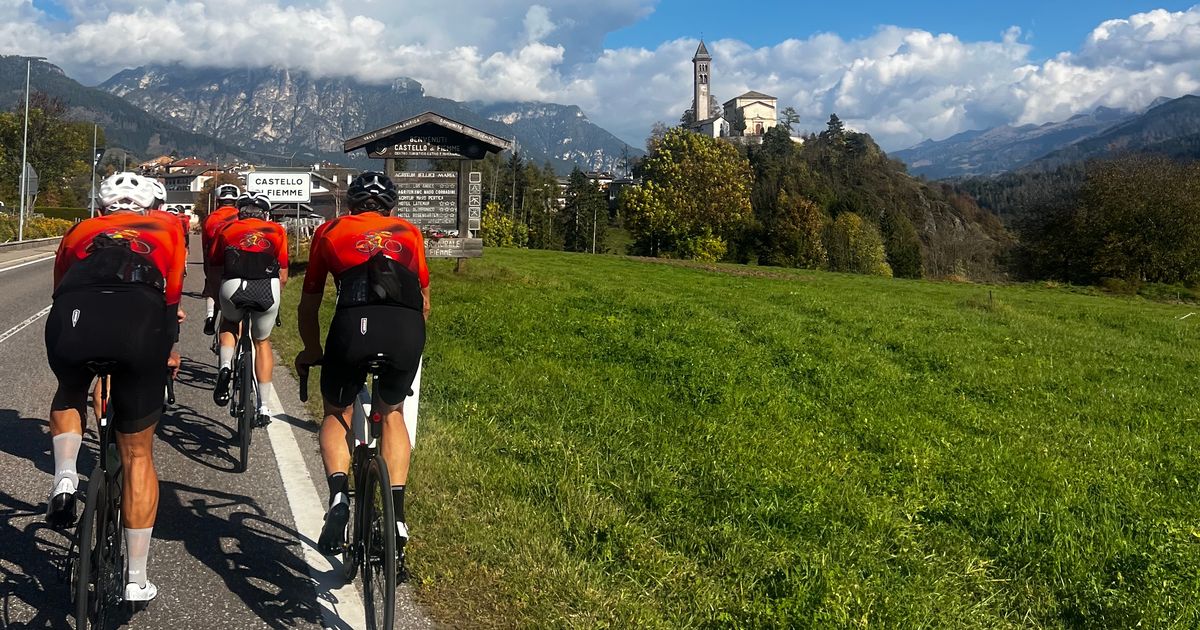
EXCLUSIVE Daily Star Sport was present for the launch of Q36.5’s latest product that has been called an “evolutionary leap” for cycling
The last of the summer sun had started to set behind the mighty Italian Dolomites.
It’s early October in Bolzano, and the golden rays of warm sunshine felt increasingly fleeting as autumn emerged, turning leaves brown before they fell from the trees.
Northern Europe’s traditional cycling season had already come to a close after World Champion Tadej Pogacar had rolled across the finishing line just down the road in Il Lombardia. And yet Daily Star Sport had still found itself in this small corner of the world for an ambitious project.
Q36.5, based in this small Italian city that feels more like an Alpine town than a bustling urban centre, was preparing to launch what it called an “evolutionary leap” in a sport often anchored to tradition.
Cycling can be slow to embrace innovation – look no further than how long it took for the peloton to accept disc brakes over the more traditional rim variation.
Yet, the company’s founder, Luigi Bergamo, is keen to move the sport into the future, and his collaboration with SRM is the latest step in an ambitious plan to reduce stack height and improve pedalling efficiency.
Pedal stack height is the distance from the centre of the pedal axle to the surface where your cleat contacts the pedal. While shoe stack height is the total thickness of the shoe’s sole, including the insole, midsole, and outsole.
By reducing this, he hopes to “offer the most direct and efficient power transfer on the market”.
The idea was born from a late-night discussion between Bergamo and SRM’s founder, Ulrich Schoberer. “Wouldn’t it be possible”, he asked Schoberer, who has long tweaked existing marketing pedal designs for his own needs, “to design a pedal that reduced stack height even further?”
After six months and numerous napkin sketches, he was able to provide Q36.5 – as well as two Grand Tour winners with a passion for innovation – with the first working prototype of the product.
And in the high Italian Dolomites, Daily Star Sport had the opportunity to test out the shoe and pedal system before it was announced to the public across a 100km route that didn’t climb too far from where the Winter Olympics will be held.
We were handed the shoes the evening beforehand, accompanied by a presentation about the project.
By lowering the stack height, Bergamo and Schoberer would lower a rider’s centre of gravity and place their foot closer to the centre of the circular pedalling motion, allowing more power to flow through each stroke.
The sun was quickly replaced by the crisp Alpine air as the road wound skywards, and I had the chance to test out the shoes and their power potential.
And the quiet road that snaked up the pass allowed me to try and put the power through the pedals – mainly to catch up with the group ahead, which featured 1988 World Champion Maurizio Fondriest, who had already dropped me thanks to my less-than-perfect descending skills.
I was in the second group on the climb, not fancying testing my legs against 2014 Tour de France winner Vincenzo Nibali, who still looked like he could hold his own with the professionals.
I was later told by a member of that group, Nibali, who had spent most of the climb chilling at the back of the group, showed off his style by riding everyone off his wheel close to the summit.
Meanwhile, several kilometres down the road, I discovered how responsive the pedals felt during the short 30-second bursts required to catch up to my group whenever the road dropped into the valley.
It’s not just the direct power transfer that’s impressive; the lower stack height allows for a lower saddle and a more aerodynamic position on the bike.
Lowering the centre of gravity, and the saddle height, also compensates for the move to shorter crank lengths that has swept the sport in the past 12 months.
It’s just a change in the pedal, but as Q36.5 put it, it makes you feel like you’re “inside the bike” – the performance gains were evident during quick sprints and holding an aero position on the flat.
However, there was also a greater sense of confidence.
Alpine descents are filled with tight switchbacks, which act as a negotiation between bravery and caution, but the reduced centre of gravity brought a sense of steadiness through the fast bends.
It was already evening when I punched up the sharp climb back to the hotel, one last descent had seen me have to cycle the final 5km back alone.
However, it gave me a chance to reflect on the new system – It’s not just a new gimmick in the pursuit of trying to do something different, it feels like a genuine step in the sport’s ongoing search for perfection.
It’s a small change on the bike, but unmistakable in what it adds to the ride.
#Q36.5s #game #changing #launch #evolutionary #leap #cycling